
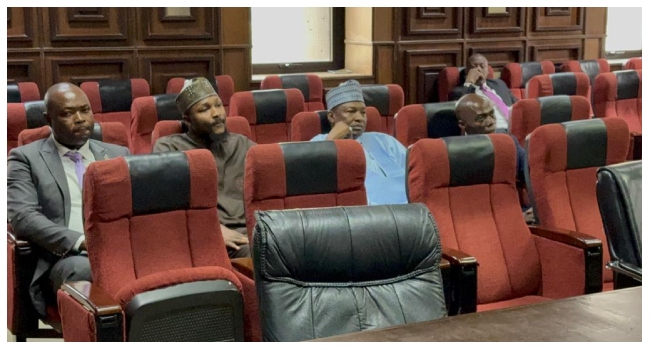
The Federal High Court in Abuja has fixed July 10, 2026, to deliver judgment in the suit filed by the Economic and Financial Crimes Commission (EFCC) seeking the final forfeiture of 57 properties allegedly linked to former Attorney-General of the Federation and Minister of Justice, Abubakar Malami.
The case, which came up on Monday before Justice Joyce Abdulmalik, was originally slated for judgment after both parties adopted their final written addresses and concluded their arguments on May 26. However, the court deferred its decision and adjourned the matter until July 10.
The EFCC is asking the court to permanently forfeit the 57 properties to the Federal Government, arguing that they are reasonably suspected to be proceeds of unlawful activities.
During the earlier proceedings, counsel to the anti-graft agency, Jibrin Okutepa, SAN, urged the court to grant the Commission’s application. He relied on a 47-paragraph affidavit and 46 documentary exhibits filed in support of the motion, maintaining that the evidence before the court justified the permanent forfeiture of the assets.
Okutepa argued that Malami and the other respondents had failed to provide satisfactory explanations regarding the legitimate sources of the properties. He therefore urged the court to uphold the EFCC’s application and order that the assets be permanently forfeited to the Federal Government.
Opposing the application, Malami’s counsel, Adedayo Adedeji, urged the court to dismiss the suit and set aside the interim forfeiture order that had earlier been granted.
Relying on a counter-affidavit sworn to by Malami, Adedeji argued that the EFCC’s case was based largely on suspicion rather than concrete evidence.
“The court deals with evidence, not suspicion,” he submitted.
The defence further argued that the anti-graft agency relied heavily on extra-judicial statements that should ordinarily be tested through cross-examination during a criminal trial. Counsel noted that the court had previously declined to hear oral evidence in the proceedings, making it inappropriate to rely on such statements as the basis for a final forfeiture order.
Adedeji also maintained that several of the disputed properties were acquired before Malami’s appointment as Attorney-General of the Federation, insisting that such assets could not reasonably be classified as proceeds of crime.
Lawyers representing the other respondents and companies listed in the suit also aligned with Malami’s position, urging the court to reject the EFCC’s application for permanent forfeiture.
Justice Abdulmalik subsequently adjourned the matter until July 10, 2026, when the court is expected to determine whether the disputed properties should be permanently forfeited to the Federal Government or returned to the respondents.
Meanwhile, Malami is also facing two separate criminal cases before another judge of the Federal High Court in Abuja. One charge relates to alleged money laundering, while the other concerns the alleged unlawful possession of firearms. Both cases remain pending before the court.


0 Comments