
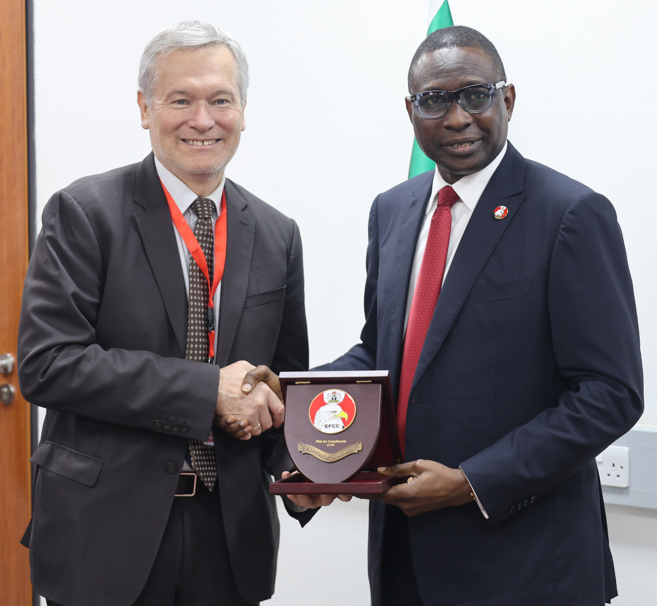
The European Union (EU) has reaffirmed its commitment to strengthening its partnership with the Economic and Financial Crimes Commission (EFCC), particularly in the areas of anti-corruption, cybercrime, training, and financial crime investigation and prosecution.
EU Ambassador to Nigeria, Gautier Mignot, stated this in Abuja on Tuesday, July 28, 2026, when he led a delegation on a courtesy visit to the corporate headquarters of the EFCC.
Stressing the strategic importance of the EFCC and the basis for the partnership with the Commission, he stated:
“The role of the EFCC is so important for us, both for the stability and prosperity of Nigeria and for our partnership, to be able to tell our potential investors: ‘You can safely come to Nigeria. There is a compliant business environment because you have strong institutions like the EFCC to make sure that this is the place.'”
Mignot expressed satisfaction with the longstanding partnership between the EU and the EFCC, which he said had existed since the establishment of the Commission, noting that the relationship had continued over the years, particularly through the Rule of Law and Anti-Corruption (RoLAC) Programme.
He assured that the EU remained committed to continuing the partnership and supporting efforts to strengthen the institutional capacity of the EFCC, improve investigative effectiveness, and enhance prosecution.
“We are very much committed to continuing this partnership, doing whatever we can do to strengthen the institution, improve investigative effectiveness, and prosecution,” he said.
He further stressed that the EU had ongoing initiatives aimed at supporting the fight against cybercrime, describing the issue as a priority for the EFCC in view of its growing prevalence. To further strengthen this effort, he disclosed that the EU had proposed training for EFCC personnel on the Cybercrime Response Centre, with the modalities of the training still being worked out.
He added that the EU was also strengthening its support for Anti-Money Laundering and Countering the Financing of Terrorism (AML/CFT) compliance while congratulating the EFCC on its efforts in the fight against corruption and cybercrime.
He said the visit was taking place at a very important moment in the EU-Nigeria partnership, stressing that the EU, alongside its 14 member states, remains a major trading, investment, and development partner of Nigeria.

According to him, the EU is committed to deepening its partnership with Africa and leveraging greater private investment, particularly by mobilizing European companies to partner with Nigerian businesses to develop local manufacturing value chains and other sectors, including agriculture.
“Governance issues remain a core priority for us, also as an enabler for investment and for the operations of EU companies,” he said.
The Ambassador noted that European companies are particularly attentive to the business environment and compliance issues, stressing that the role of the EFCC is therefore important to the stability and prosperity of Nigeria, as well as to the EU-Nigeria partnership. He expressed optimism that the existence of strong institutions such as the EFCC would give potential European investors confidence to do business in Nigeria.
Responding, the Executive Chairman of the EFCC, Mr. Ola Olukoyede, described the Commission as Nigeria’s foremost anti-corruption agency, responsible for coordinating the investigation and prosecution of financial crimes in the country.

Olukoyede said the Commission had, over the years, continued to work towards ridding the country of economic and financial crimes, noting that it had recently recorded significant progress in the fight against cybercrime and terrorism financing.
“Over the years, we have strived to ensure that the country is rid of economic and financial crimes. Recently, we recorded a modest achievement in the fight against cybercrime and terrorism financing. We were taken off the grey list of the Financial Action Task Force (FATF), and we are looking forward to doing more,” he said.
The EFCC Chairman recalled that while appearing before the National Assembly during his screening and confirmation process, he had assured Nigerians that he would use his position and the instrumentality of the anti-corruption fight to stimulate the economy and attract investment into the country.
He said the Commission’s anti-corruption mandate was not only about investigating and prosecuting financial crimes but also about creating an environment where legitimate businesses and investments could thrive.
Olukoyede explained that the proposed Cybercrime Response Centre was part of efforts to protect investments and strengthen the country’s response to cybercrime.
He said the Centre, when fully operational, would operate 24 hours a day, seven days a week, with the capacity to respond to reports in real time, gather intelligence, process petitions, and act on relevant information.
“The essence of the Centre is to handle real-time reports, gather intelligence, respond to petitions, process information, and all of that,” he said.
Olukoyede assured the EU Ambassador and European countries of the Commission’s readiness to support legitimate investors and protect the business environment from the threats posed by economic and financial crimes.
“Rest assured that we are here to support all EU countries, particularly their investors,” he said.


0 Comments